

Explore the program:
Welcome & About Us | Bios | About the Play | Swag & Support | Civics is Sexy | Survey
About the Play
by Dr. Sid Ray, Pace University & Clare Kearns, Brown University, PhD Candidate
Shakespeare’s The Tragedy of Julius Caesar (1599) covers a crucial period of Roman history. It begins in 44 BCE, when Caesar returns to Rome after winning the civil war he began against Pompey four years earlier.
Our play opens with the people celebrating Caesar’s victory and during the Feast of Lupercal. Many Romans admire Caesar—but some leaders are disgusted with his consolidation of power and feel the need to act.
A group of senators spurred by Cassius plots to stop Caesar. To be successful, Cassius needs the respected, even-handed Brutus to join the conspiracy. Brutus, who we have gendered female, is conflicted: she cares about Caesar, but believes the Roman Republic is in danger of becoming a monarchy. She is ultimately persuaded that assassinating Caesar will protect the Republic. The conspirators see themselves as acting for the “common good,” even as their secrecy and manipulation suggest how easily republican ideals can be compromised by ambition, jealousy, and fear.
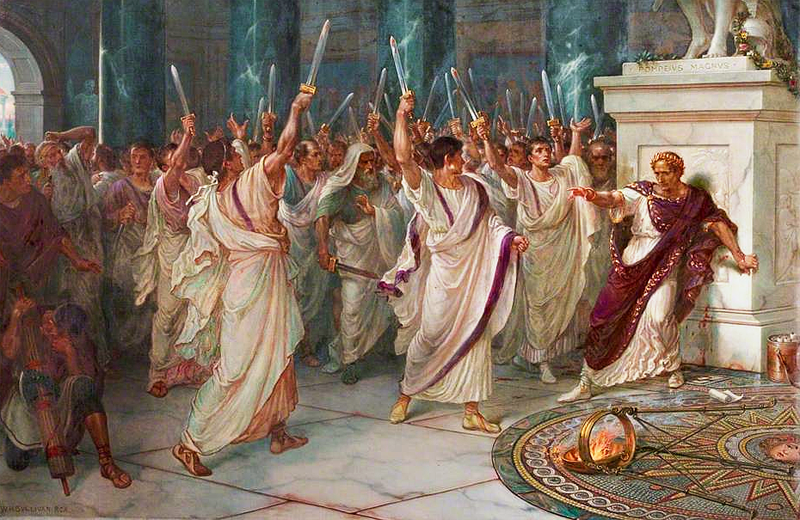
The dramatic assassination—one of the most notorious moments in history and carefully orchestrated by the conspirators—backfires politically. In our version, seven senators stab Caesar to death in public on the Ides of March. After he is killed, Brutus speaks at Caesar’s funeral to justify the act as a defense of the republic, but she speaks with reason, not passion. Then Mark Antony, Caesar’s ally, speaks to the crowd. Through rousing verse (poetic speech) and emotional timing, he turns the crowd into an angry mob against the conspirators.
The city erupts, leaving Antony, Octavius (Caesar’s heir), and Lepidus (another of Caesar’s allies) to collude against Brutus and Cassius’s faction as Rome descends into yet another civil war.
Julius Caesar is not a simple story with clear heroes and villains. Shakespeare sides neither with Caesar nor with Brutus but presents them both as humans with physical and mental strengths and weaknesses who make grave errors in judgment. Instead of promoting one side over the other, Shakespeare invites us to wrestle with the play’s ambiguities and paradoxes and decide for ourselves whether the conspirators were justified or reckless and foolish.
The play raises a host of difficult questions: When does protecting republican freedom begin to undermine it? How do political leaders sway public opinion—through evidence, values, emotion, or fear? How do we differentiate between a good speaker and a good leader? How do we address the inequities that continue to exist even in a republic? What responsibilities do citizens have in moments of uncertainty? And once violence enters politics, can a society ever find its former stability?
New York Classical Theatre’s Julius Caesar
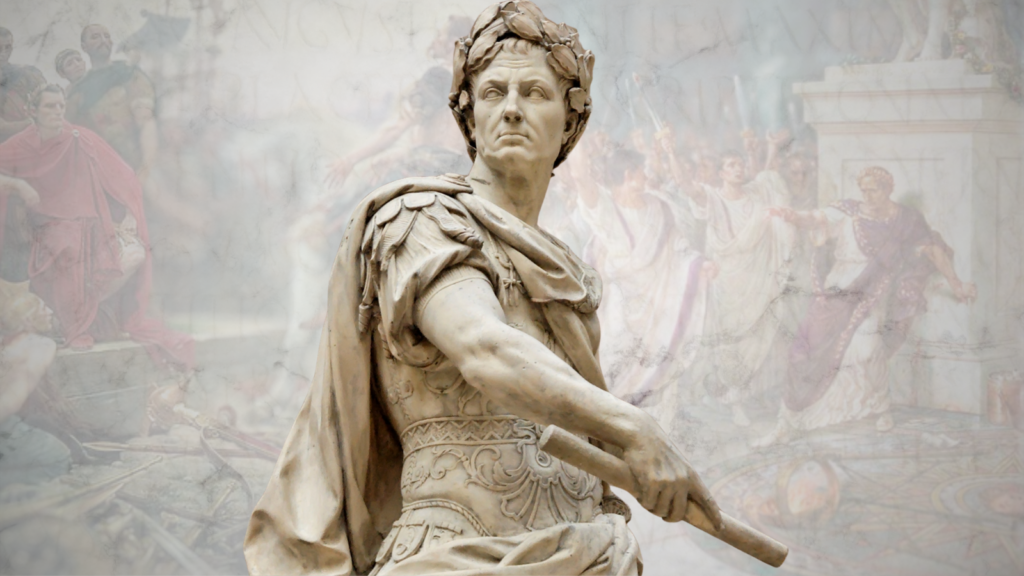
Our production of the play is adapted for the time we live in and the places we perform. We tell the story with only 9 actors, 5 female and 4 male (6 fewer than Shakespeare’s original company in 1599). Notably, Brutus, Cassius, and Octavius, among others, are portrayed by, and as women. We also remove material that would be needlessly offensive to audiences in 2026.
History vs. Fiction
Julius Caesar came to power when Rome was at its most unstable. Since 509 BCE, Rome had been an aristocratic republic, a form of government in which power is concentrated among an elite minority. There were three branches of government: the executive magistrates, the senate, and the popular assemblies. To varying degrees, each branch was controlled by wealthy, landowning men; certainly no women or enslaved people were able to participate or vote. At many points in the 400 years before Julius Caesar was born, the Republic was troubled by conflicts between these elites and non-elite Roman men, who often allied themselves with popular politicians promising to champion their causes. Caesar was one such politician, first elected consul in 59 BCE, who was able to leverage his popularity to wage civil war in Rome and declare himself dictator perpetuo, “eternal dictator.”
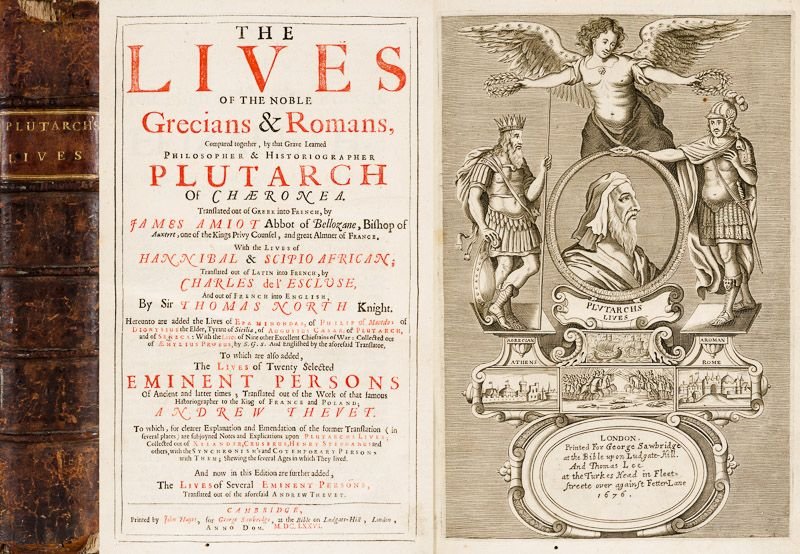
Plutarch’s Lives of the Noble Grecians and Romans
Because Shakespeare’s Julius Caesar is based on Roman history, Shakespeare wasn’t inventing the story from scratch—he was shaping it for dramatic impact by compressing the time frame, developing character ambivalences, and raising characters’ personal stakes. For this play, he drew upon English translations of classical historical writing, especially Plutarch’s Lives of the Noble Grecians and Romans (through Sir Thomas North’s translation), which offered vivid yet distorted portraits of Caesar, Brutus, and Antony. Thus, in this historically-based tragedy, Shakespeare writes with a different purpose than playwrights who invent the plot: the “what” (what happens) is largely known, so the drama comes from the “how” and “why.” He selects the key incidents to include and crafts scenes that illuminate motivation, raise moral stakes, and showcase the power of verbal persuasion—turning recorded history into a political nail-biter.
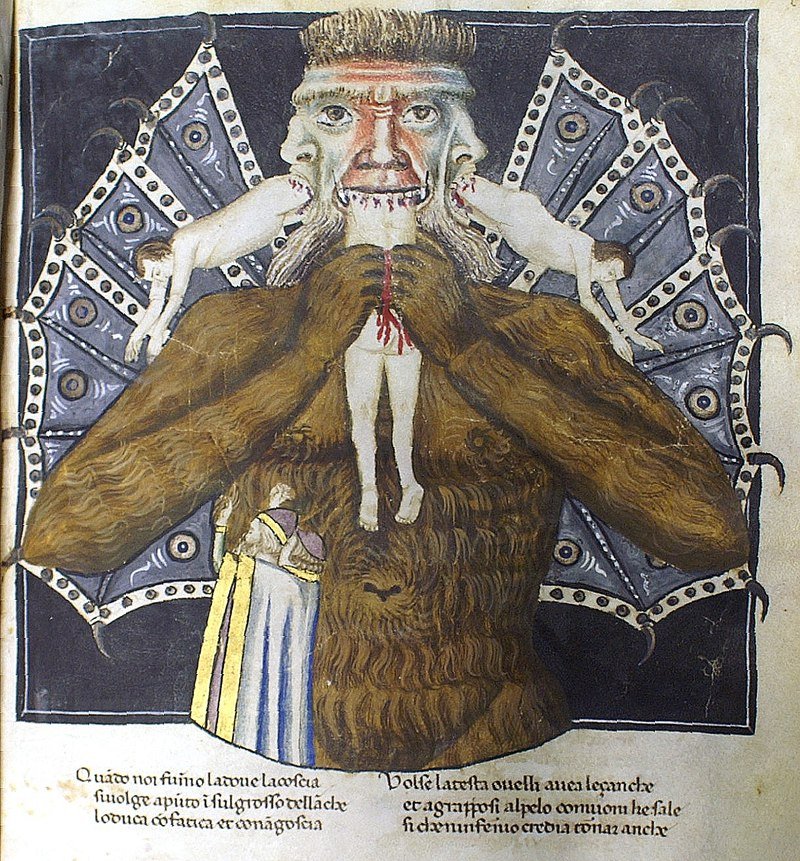
Dante’s Inferno by Vikram Puri
Major medieval authors differed on their assessment of Brutus. Dante puts Brutus and Cassius in the lowest circle of hell alongside Judas. Chaucer, in “The Monk’s Tale,” deems Caesar a victim betrayed by “false Brutus.” Shakespeare departs from medieval tradition by elevating Brutus to the level of an intellectual, ambivalent politician, torn between private affection for Caesar and duty to the polity.
Plutarch’s Caesar is more inclined to tyranny than Shakespeare’s Caesar, who leaves us guessing—would he have accepted the crown if it were again offered to him? Other of Shakespeare’s embellishments to Plutarch’s narrative include Caesar’s deafness, the details of Brutus’s and Antony’s speeches, and the character of Lucius, Brutus’s servant. He also compresses the timeline to increase the pace and tension of the story.
Themes and Concepts
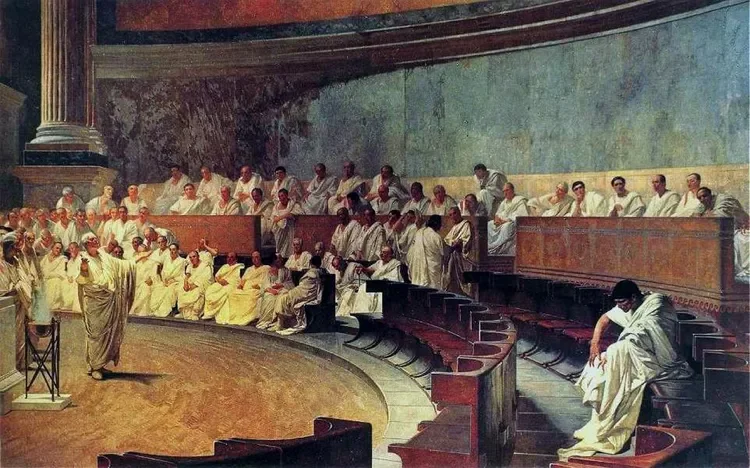
Roman Senate in session on a 19th century fresco in the Palazzo Madama, Rome.
Rome’s Aristocratic Republic vs. the US Democracy: While it is tempting to compare the ancient Roman republic to our constitutional democracy in the United States, the differences are stark. Ancient Rome’s republican system was aristocratic, meaning most political power was concentrated among a handful of elites. Senators in ancient Rome were appointed rather than voted in, and Rome had no independent judiciary.
The mob: Shakespeare gives us a fickle Roman populace that changes its minds in an instant. The people are easily swayed by rhetoric and charisma into becoming destructive forces acting against their own best interests.
Gender: Early modern England was a hostile place for women, but that does not mean they did not have agency! Women were blamed for the “Fall of Man” in Judeo-Christian origin stories. In science and medicine women were perceived to be less perfect versions of men. Following the theory of the bodily humors, they were considered cold and moist, while men were hot and dry. Because of their so-called imperfections, it was believed that women should be controlled and subservient to men.
Women were told to keep to the private world of the home while men were told to go out in public to make their fortunes. Of course, women defied restrictions and attempts to keep them down. After all, the ruler of England for the first half of Shakespeare’s career, Queen Elizabeth I, was a woman!
Ancient Rome was not a happy time for women either. In antiquity, Caesar was often mocked for his supposed femininity and his romantic relationships with other men. In an ancient biography of Caesar, Suetonius writes that Caesar was rumored to have had an affair with the King of Bithynia, often being teased as the “Queen of Bithynia,” and that the politician Curio proclaimed in a speech that Caesar was “every man’s woman, and every woman’s man.”
Time: Time was truly out of joint for Shakespeare in 1599. In 1582, Pope Gregory had mandated a change from the Julian calendar (named after Julius Caesar) to the Gregorian Calendar. Holidays (holy days) were vestiges of Catholicism, so it was rather unclear what calendar people were using to determine the day off work. England would not shift to the Gregorian calendar until 1752, but other countries had already adopted the new calendar, and there were 10-day discrepancies across Europe. In 1599, Londoners celebrated Easter two weeks before most other Europeans.
Et tu, Brute?: The famous phrase “Et tu, Brute?” is a modern invention. In antiquity, it was popularly believed that Caesar instead spoke to Brutus in Ancient Greek, not their native Latin, saying “kai su, teknon” (“and you, my child”) as his friend joined in on the assassination.
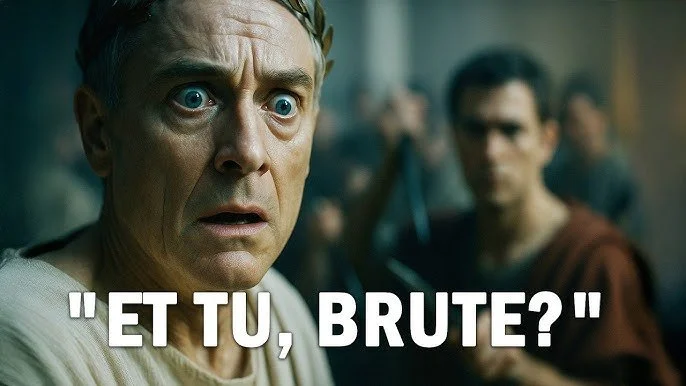
There are several ways to interpret this phrase. In one interpretation, “and you, my child” reflects Caesar’s confusion that a friend, whom he addresses with the affection “my child,” would want to kill him. In another, “and you, my child” is understood as a condescending jab at Brutus, who was younger than Caesar. (This interpretation emphasizes that the Greek words kai su were often used on Greek curse tablets to ward off evil, suggesting that saying “kai su, teknon” was Caesar’s way of cursing Brutus for his deed. As Jeffrey Tatum translates it: “See you in hell, punk!”).
Another interpretation recognizes that kai su, teknon was also the beginning words of a Greek proverb that meant “and you, my child, will have a taste of power,” and holds that Caesar was anticipating Brutus’ own death.
We will never know if Caesar actually said kai su, teknon to Brutus. Even the ancient biographers who wrote down the phrase were skeptical about its veracity. In any case, these words have become infamous, as they succinctly represent the moral ambiguity and trenchant emotion of Caesar’s assassination.
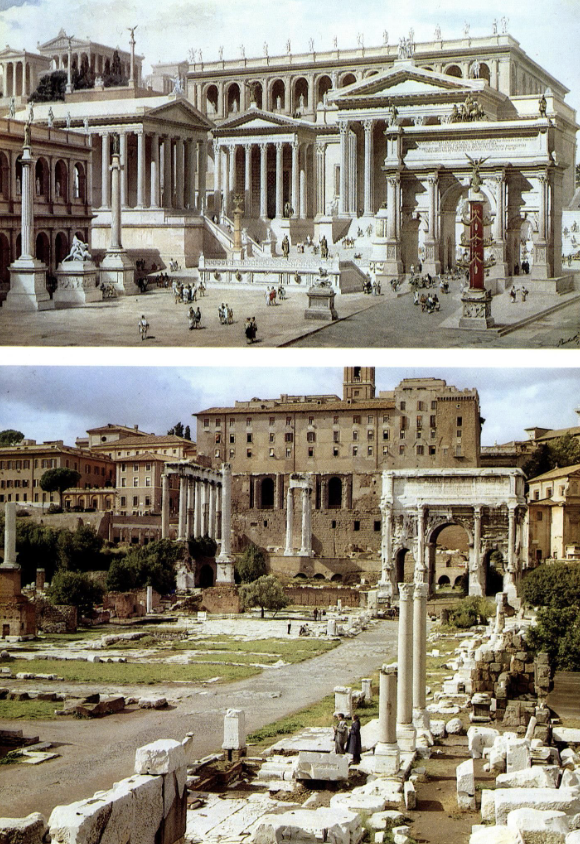
The Roman Forum
Genre
Julius Caesar is a tragedy—but it’s more than the story of one person’s downfall. Caesar dies midway through the play, so the tragedy rests, in part, on the consequences of the act as well as the development of “caesarism”–a system in which one charismatic, popular ruler takes charge. In our production we see that once Julius Caesar is killed, Octavius, his heir, arrives to replace him. Shakespeare’s tragic vision is of a world in crisis that resonates with his own political realities. The play moves quickly, shifting between private plotting and public performance as leaders compete to control Rome’s future. It also includes moments that feel almost comic (especially with the commoners and the quick shifts in public opinion), but there is no real clown or fool in this play as there are in many of Shakespeare’s other tragedies.
Place
The action of the first three acts takes place in ancient Rome, but then it shifts eastward to battlefields and encampments near and Philippi (northern Greece). The action moves between large areas filled with people and secluded outdoor meeting places. Like Shakespeare we use these settings to suggest that political power isn’t only decided behind (literal) closed doors—it’s also performed, contested, and judged in public spaces (not unlike theatre).
At New York Classical Theatre, we bring that sense of public life into the open air. Throughout the performance, audiences follow the actors through the park as scenes shift from one location to another. Instead of staying in one fixed space, we make the park our stage—our signature performance style, Panoramic Theatre, mirrors the play’s movement between intimate conversations and public events.
Key Characters
As a reminder: Our production of the play is adapted for the time we live in and the places we perform. We tell the story with only 5 female actors and 4 male actors (6 fewer than Shakespeare’s original company in 1599). Notably, Brutus, Cassius, and Octavius, among others, are portrayed by, and as women.

From left to right: Julius Caesar, Brutus, Cassius, Mark Antony, Casca, Portia, and Calpurnia.
Julius Caesar: A celebrated Roman warrior returning from victory against a formerly beloved Roman leader–Pompey the Great. Caesar is admired by the plebeians and wields immense power—so much that the senators fear he will become a king (a terrifying idea even in this form of republic). Caesar is confident and ambitious, but Shakespeare makes him deaf in one ear and susceptible to epileptic seizures (the “falling sickness”). Whether Caesar is seeking absolute authority or just basking in public adoration is one of the play’s central questions.
Brutus: A respected Roman senator known for honor, restraint, and devotion to Rome who “sits high in all the people’s hearts” (1.3.157). The play’s moral center, Brutus wrestles with her conscience about killing her friend, who she fears will become a tyrant. Brutus nevertheless joins the conspiracy believing she is acting for the good of the republic. A deep thinker, Brutus is a precursor of Hamlet and Macbeth, characters Shakespeare developed later in his career.
Cassius: The main architect of the conspiracy, Cassius “has a lean and hungry look” (1.2.193). She distrusts Caesar, resenting and envying his authority. She is a “machiavel”—who knows how to manipulate Brutus’ values and anxieties in order to recruit her. Cassius believes the people need to act against a ruler who consolidates too much power: “The fault, dear Brutus, is not in our stars / But in ourselves, that we are underlings” (1.2.139-140).
Mark Antony: Caesar’s close ally, friend, and one of the play’s most effective political strategists—“a shrewd contriver” (2.1.178). In the wake of the conspiracy, Antony appears loyal and grieving, but he quickly proves himself a brilliant orator who can move a crowd. His Act 3 funeral oration turns the tide—and serves as a lesson in the power of rhetoric. But, is Antony devastated by Caesar’s death, or does he see it as an opportunity for his own political ambitions?
Casca: A blunt, cynical, superstitious senator. Casca narrates the events and serves as a bridge between the private world of conspiracy and the public world of rumor, spectacle, and opinion.
Portia: Brutus’s spouse. Intelligent and perceptive, Portia insists on being treated as an equal partner, not someone to be protected by secrecy. To get her wife’s respect, she wounds herself in the thigh. Later she will “eat fire.” Through Portia, Shakespeare shows the personal cost of political life—and the strain that secrecy and fear place on relationships.
Calpurnia: Caesar’s wife. Calpurnia dreams of her husband’s demise and fears the worst. She pleads with Caesar to stay home on the Ides of March. Her character highlights a recurring theme in Shakespeare: ignoring warning signs (omens, dreams, feelings) can have devastating consequences. Like Portia, Calpurnia is ignored and side-lined.
Octavius: Caesar’s young heir who appears for the first time in Act 4 as ruthless, cold-hearted, and decisive.
Cinna the conspirator vs. Cinna the poet: Cinna is one of the 7 conspirators who stabs Caesar to death. When the angry mob later confronts Cinna the poet, a different person, they tear her apart for having the same name and “for her bad verses.” This moment indicates the collateral damage of political instability and the price paid by people in the arts.
The Roman Citizens (the Plebeians / the Mob): Not one person, but a powerful force that can quickly turn. The plebeians can celebrate, demand, panic, mourn, and rage—and they can be swayed by a persuasive speaker. Shakespeare makes the crowd central to the tragedy: public opinion becomes a formidable weapon in the pursuit of power.
Caesarian Fun Facts & Questions:
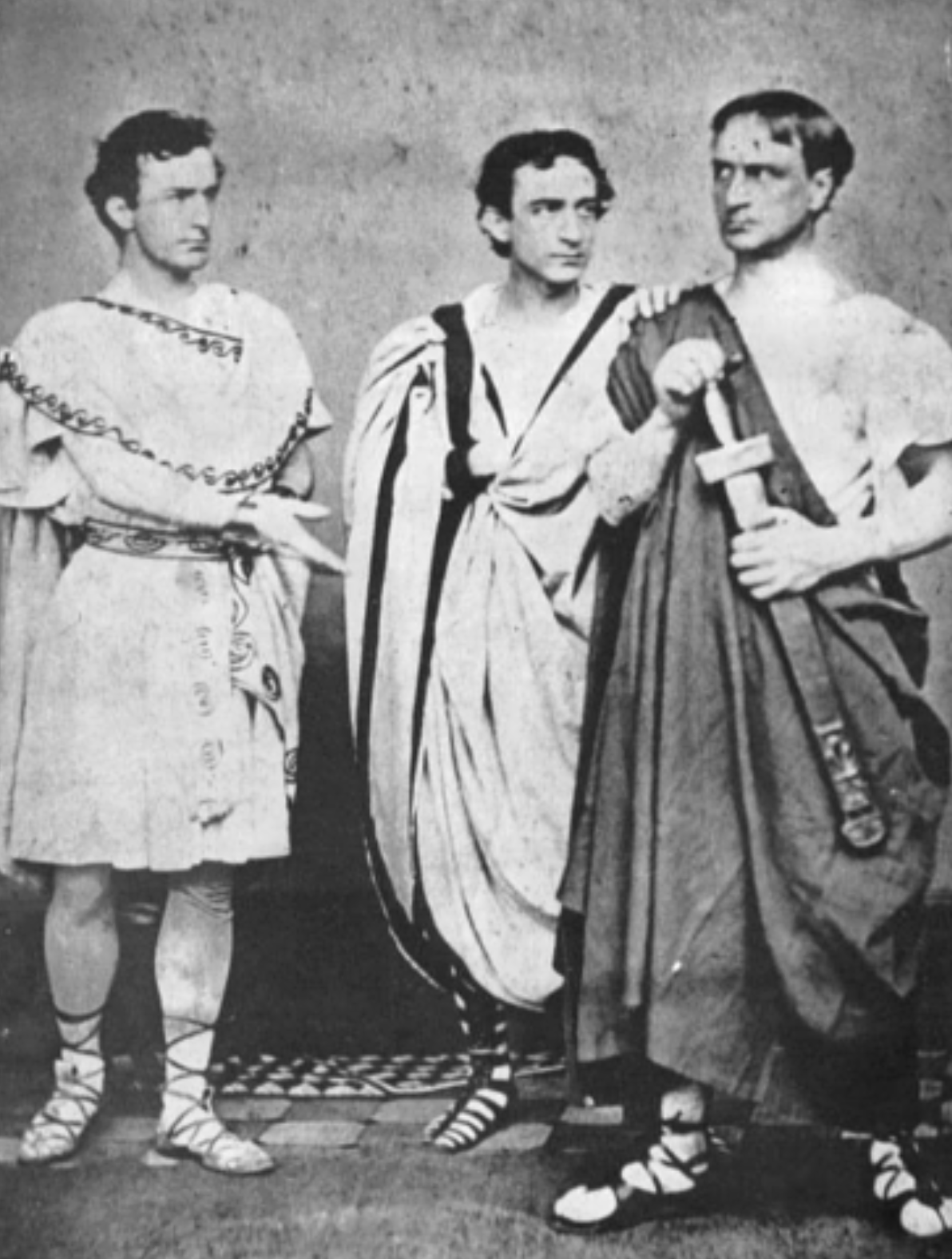
John Wilkes Booth, Edwin Booth and Junius Brutus Booth Jr. in Shakespeare’s Julius Caesar in 1864.
–The King of Diamonds in a deck of cards depicts Julius Caesar back from the Gallic Wars with a battle axe. The diamonds suggest his wealth and power. Why do you think he is depicted as one-eyed?
–Julius Caesar has 40 speaking parts, but we know it was performed with only about 15 actors in 1599. How do you think 15 of the Lord Chamberlain’s men performed this many roles?
–Shakespeare coined the term “assassination,” using it for the first time in Macbeth. The word did not yet exist when Shakespeare wrote Julius Caesar.
–In the US, the three infamous Booth brothers starred in a one-night benefit production of Julius Caesar in 1864 at the original Winter Garden Theatre in Lower Manhattan. Edwin, the leading Shakespearean actor of the day, played Brutus, Junius Brutus played Cassius, and John Wilkes played Antony. John Wilkes Booth would assassinate Abraham Lincoln less than 5 months later, shouting “Sic semper tyrannis” (Latin for “thus always for tyrants,” comparing Lincoln to Caesar).
–The Globe Theatre opened the same year Shakespeare wrote Julius Caesar. It is probable that Shakespeare chose this play to debut the theatre that would make him a rich man. Why do you think Shakespeare chose this tale to tell for such a momentous occasion?
–Julius Caesar was a very popular play in the early days of the American republic, the first known production occurring in Philadelphia in 1770. The first NYC production opened downtown on John Street in 1794. Why do you think the play was popular in the early days of the United States?
–Some form of the word ”honour” or “honourable” occurs nearly 50 times in Julius Caesar. And variations of the word “love” appear 54 times. Why do you think these words are so prevalent in the play?
–The Russian “tsar” or “czar” and the German “kaiser” derive from the Latin “caesar” and the concept of Caesarism.
– “Great Caesar’s ghost!” is Perry White’s favorite exclamation in the Superman franchise. It references Act 5 when Brutus, wracked with guilt, encounters Caesar’s ghost, but the line is not Shakespeare’s.
Final Thoughts
Shakespeare wrote Julius Caesar as a blockbuster to inaugurate the Globe Theatre, which was built the same year the play was penned. Since 1599, this Roman drama has never gone out of style. Perhaps its enduring popularity owes something to the play’s central paradox—that in killing Caesar for potential despotism, the conspirators ironically guarantee despotism. Or maybe it’s just good theatre. Whatever the reason for its lasting success, The Tragedy of Julius Caesar narrates a deeply political story that resonates across political contexts from the Elizabethan age to the American Revolution, to the American Civil War, up through today.